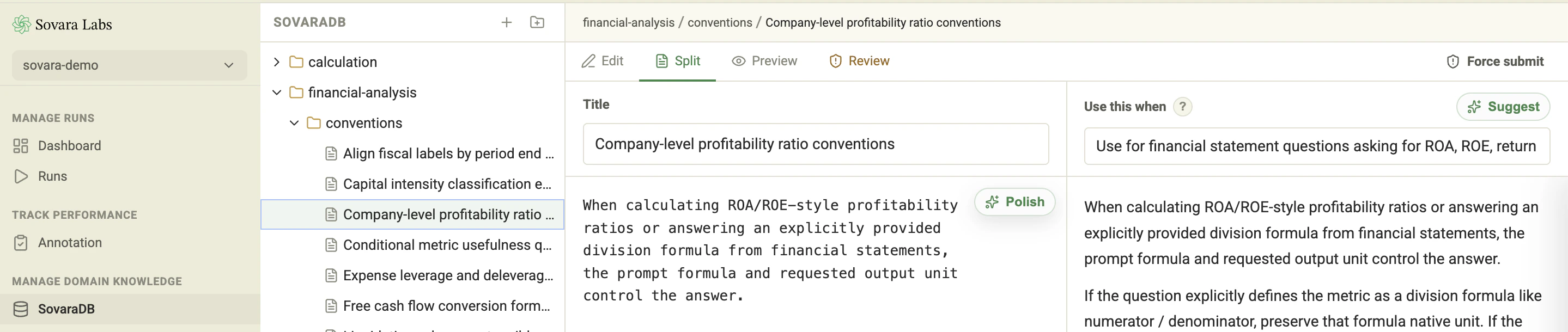
A prior is a reusable lesson that should influence future agent behavior. In Sovara, priors are stored in SovaraDB and retrieved when they are relevant to a new run. Good priors are not long notes, raw traces, or generic reminders. They are compact pieces of domain knowledge with a clear trigger.

Anatomy of a prior

A prior has three important parts:
  • Title: a short name for the lesson
  • Use this when: the retrieval trigger that describes when the prior should apply
  • Content: the instruction or domain rule the agent should follow
For example:
Title:
Quick ratio below 1.0 needs liquidity-context review

Use this when:
The task asks whether a company has healthy liquidity based on current assets,
current liabilities, or quick ratio.

Content:
When a quick ratio is below 1.0, do not conclude that liquidity is healthy from
positive management language alone. Check whether the company has offsetting
evidence such as strong operating cash flow, available credit facilities, or
temporary working-capital effects. If no offsetting evidence is present, treat
the sub-1.0 ratio as a liquidity concern.
That prior is specific enough to retrieve for liquidity analysis, but it does not overstep. It does not say every company with a quick ratio below 1.0 is in trouble. It tells the agent what extra judgment is required.

Priors are behavioral memory

Priors are most useful when they capture a reviewed lesson:
  • A failure the team wants to prevent
  • A domain distinction the agent did not know
  • A policy that should be applied consistently
  • A recurring edge case that should not be rediscovered from scratch
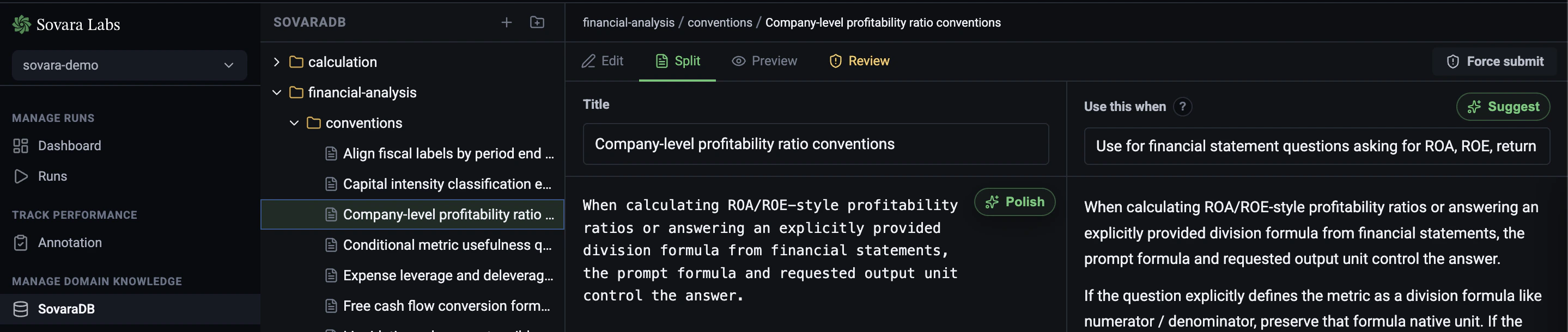
They turn review work into reusable context. Instead of relying on the agent to learn the same lesson again, Sovara can retrieve the prior when the next relevant step appears. Sovara prior editor showing title and retrieval guidance fields Sovara prior editor showing title and retrieval guidance fields Next, see how to create and maintain priors in Creating and managing priors.