

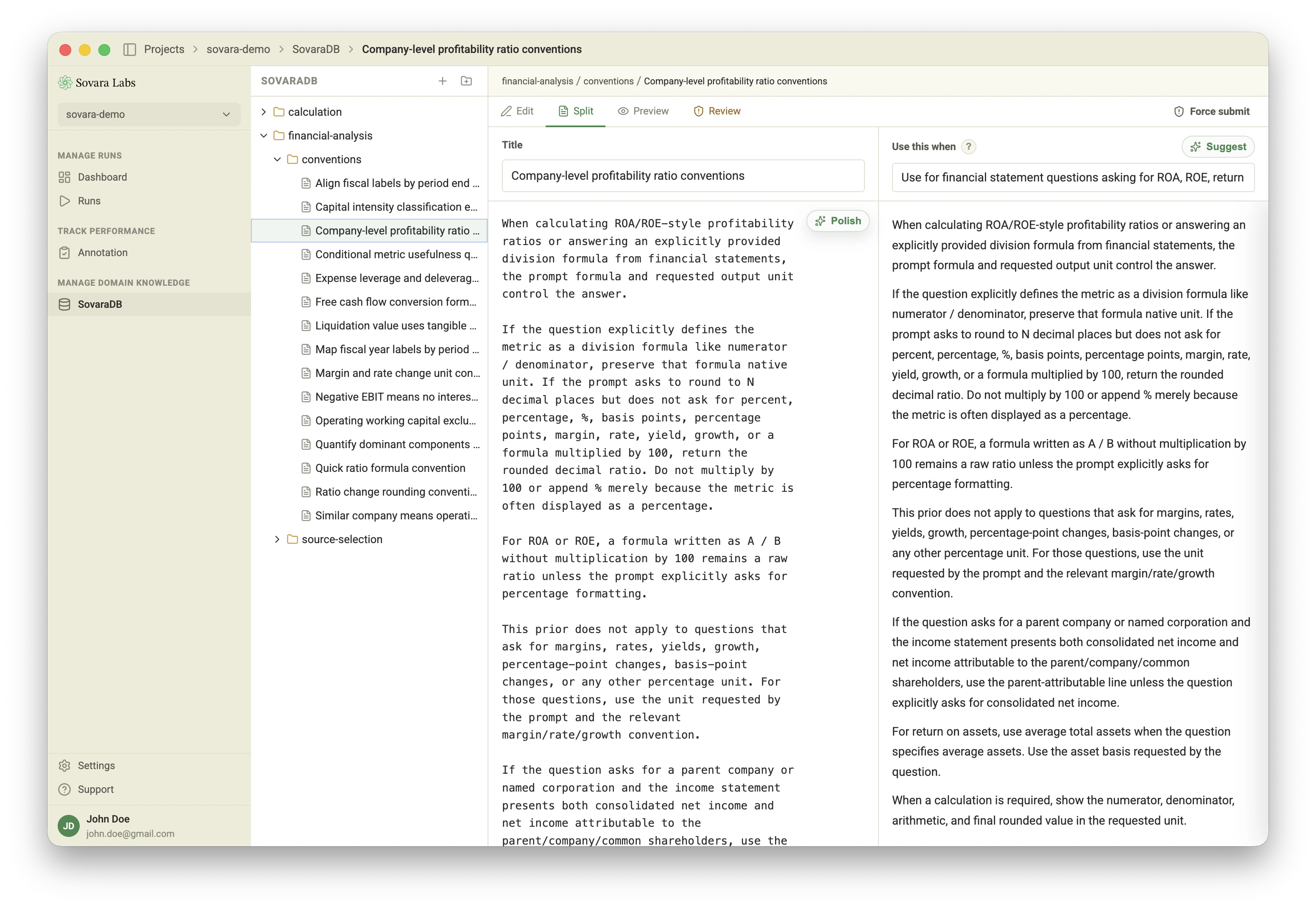
Create a prior
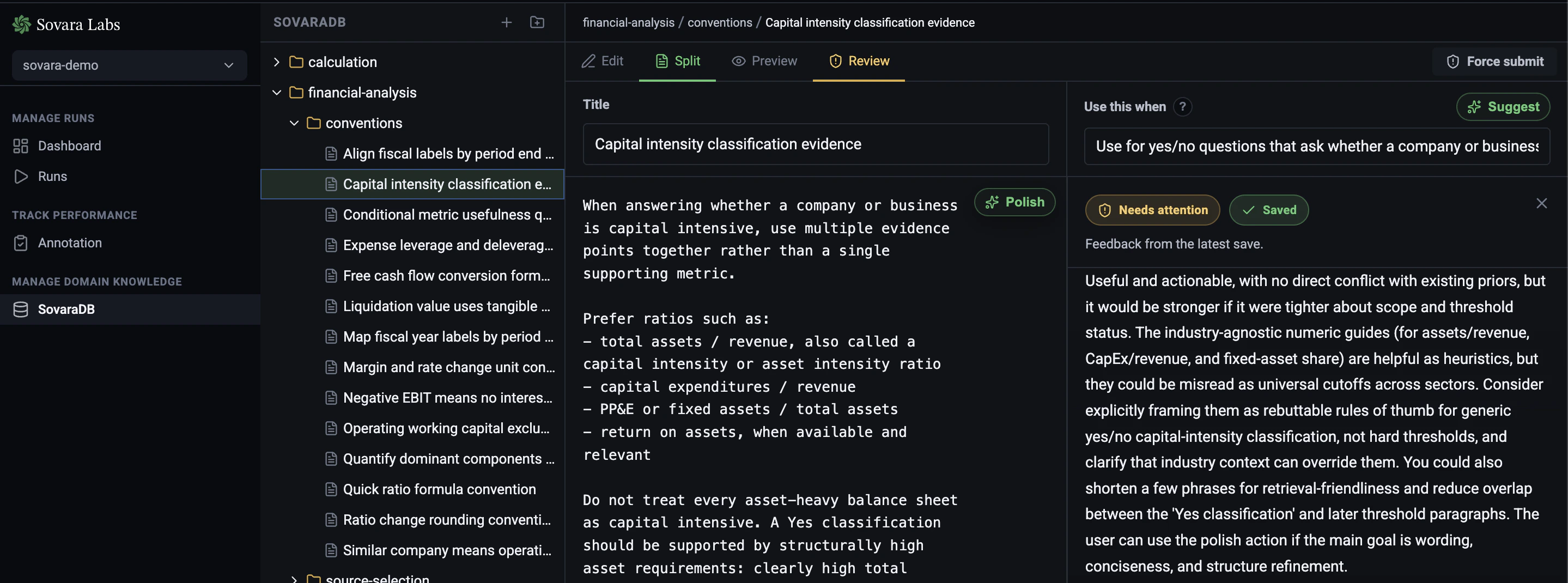
Click New Prior to create a prior, or New Folder to organize priors by domain, workflow, or product area. Fill in the prior:- Title: short and readable
- Use this when: the situations where retrieval should find this prior
- Content: the rule the agent should follow
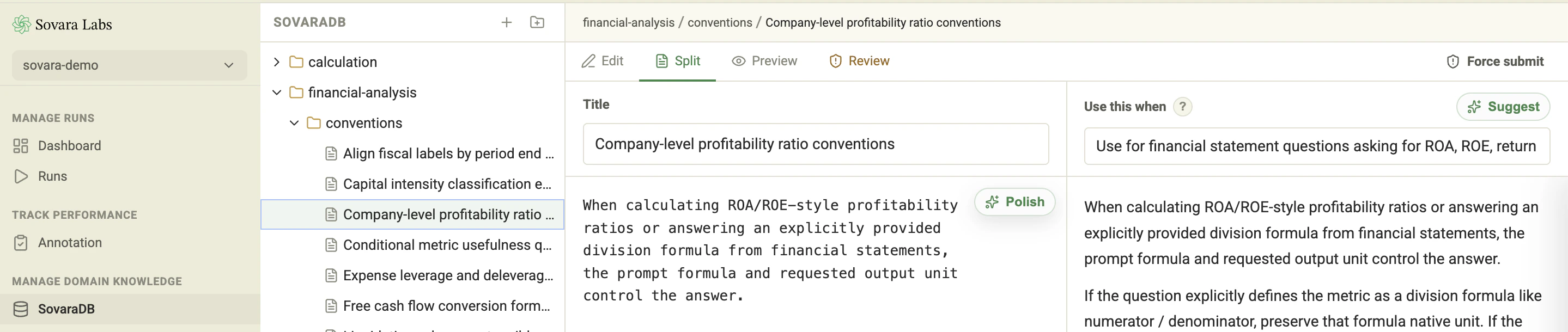
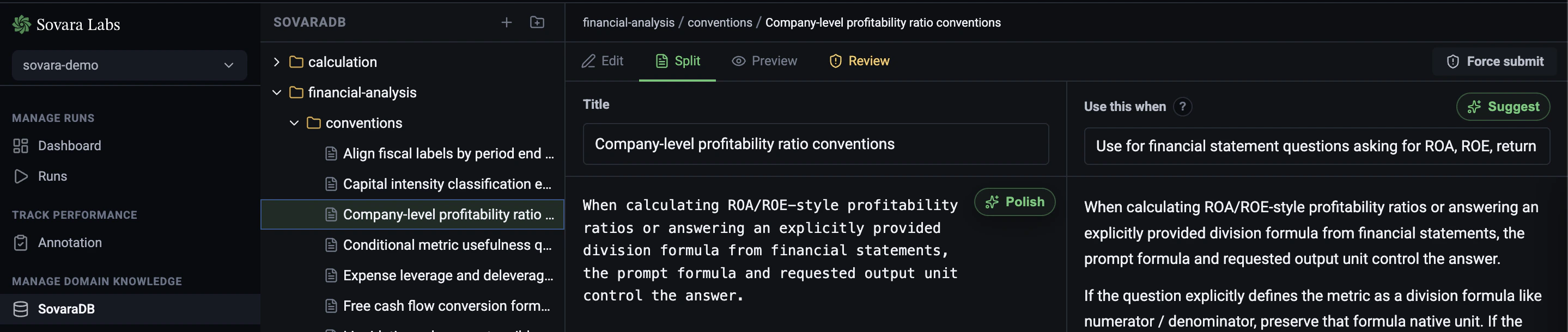
Review quality
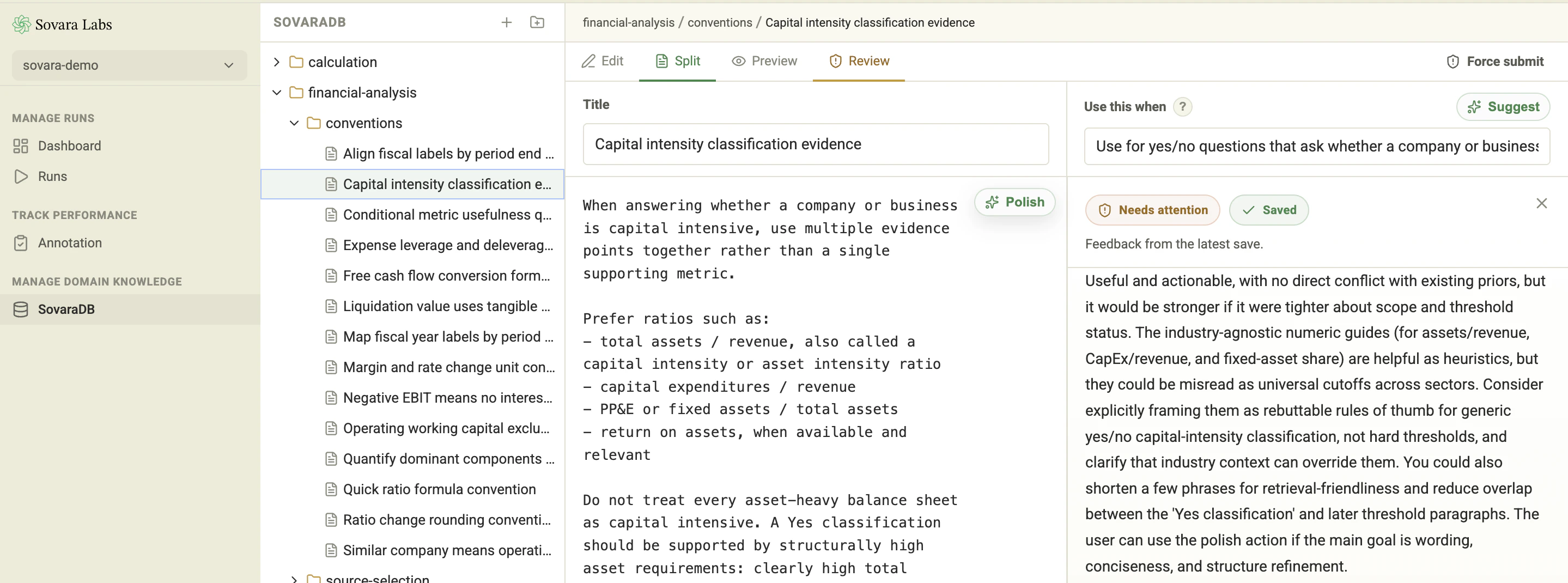
Click Review before turning an important draft into an active prior. Sovara checks whether the prior is suitable for reuse. The checks focus on practical quality:- Actionable: it tells the agent what to do differently
- Concise: it preserves the useful rule without unnecessary narrative
- Self-contained: it includes the conditions needed to apply the rule
- Precise: it avoids vague advice
- Well-scoped: it generalizes without causing mistakes in nearby cases
- Faithful: it does not invent facts or constraints
- Retrieval-friendly: it uses the terms that should trigger retrieval
- Non-conflicting: it does not contradict existing priors
Avoid duplicates and conflicts
Two priors can be individually reasonable and still make the system worse together. Sovara checks for overlap and conflict so the database does not become a pile of competing instructions. When a new prior overlaps with an existing prior, prefer one of these outcomes:- Update the existing prior if it already owns the rule
- Split the lesson if two different situations are being mixed together
- Narrow the Use this when field if the rule is firing too broadly
- Delete or archive the weaker prior if it only repeats another one
Preserve provenance
When a prior comes from a concrete run, keep the link to that run. Provenance answers the question: “Why does this prior exist?” That link is important during review. It lets someone inspect the original failure, confirm the lesson, and decide whether the prior still applies after the agent changes.Balance recall, precision, and latency
Prior retrieval has three competing goals:- Recall: missing a relevant prior can mean repeating a known mistake
- Precision: injecting too many priors dilutes attention
- Latency: retrieval should add only a small overhead to the agent run
10% of the run’s normal latency.
That is why Sovara uses retrieval-aware prior generation, compact prior content,
and project-level latency controls instead of injecting the whole database.
Next, see how Sovara applies priors automatically at runtime in Sovara’s
auto-injection.